DECODING THE CODES
The world's most comprehensive open database of crop circle formations — built for researchers, investigators, and anyone who believes the patterns in the fields deserve serious scientific attention.
WHY THIS EXISTS
Crop circles have been documented in the historical record since 1678. In the modern era, thousands of formations have appeared worldwide — the majority concentrated in southern England, with significant clusters in Germany, the Netherlands, the United States, and Australia.
Despite decades of field investigation, peer-reviewed scientific analysis of node anomalies, and geometric complexity that defies overnight human construction, crop circle research remains fragmented across dozens of independent archives, personal websites, and paywalled databases.
Decoding the Codes was built to change that — a single, open, searchable platform where every documented formation can be explored, filtered, mapped, and analyzed without a subscription.
METHODOLOGY
How we collect, classify, and analyze formation data
Primary Data Sources
Formation records are compiled from the Crop Circle Connector archive (the world's largest), ICCRA field investigation reports, BLT Research Team scientific studies, and Colin Andrews' historical documentation spanning 1978–2024.
Field Investigation Standards
Each formation is assessed for node anomalies — the bending and elongation of plant stem nodes that cannot be replicated by mechanical flattening. Confirmed node burn is the strongest physical indicator of non-human origin and is tracked as a primary data field across the entire database.
Pattern Analysis
Formations are classified by geometric shape type, complexity score (1–10), and sacred geometry archetype. Temporal and geographic clustering is analyzed to identify recurrence patterns, seasonal peaks (June–August in the UK), and correlations with ley lines and ancient sites.
Aerial Photography
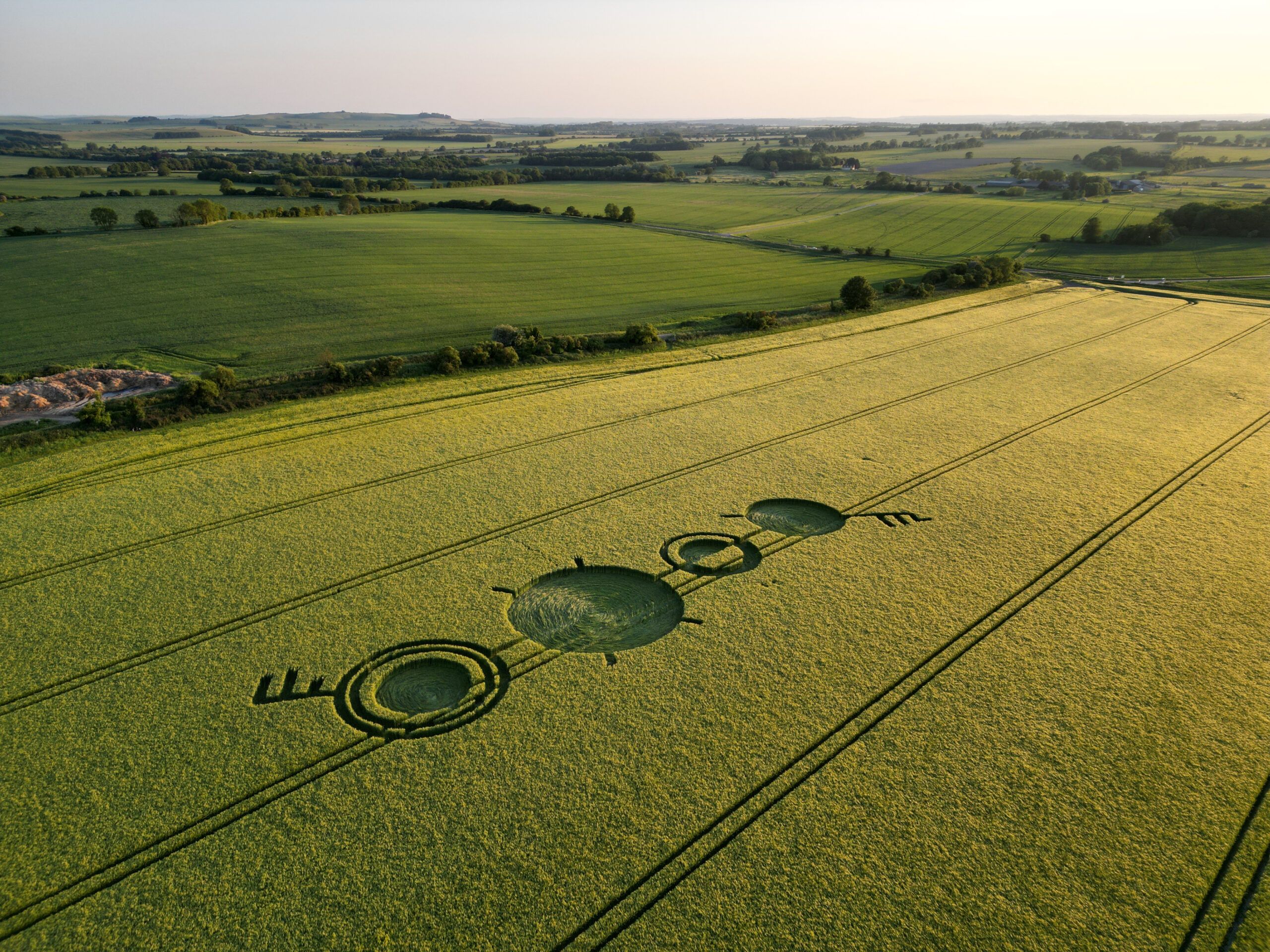
Formation images are sourced from aerial photographers, community submissions, and AI-generated reconstructions for formations where no aerial record exists. Community researchers can submit their own photographs through the Submit page — approved photos become the canonical image for that formation.
The Node Burn Indicator
The most scientifically significant characteristic of genuine crop circle formations is the elongation and bending of plant stem nodes — the joints along the stalk. In authentic formations, nodes are bent at 90° angles and elongated up to 200% of normal length, a phenomenon that requires rapid, intense heat application from within the plant tissue.
BLT Research Team's peer-reviewed studies (1999–2012) confirmed this cannot be replicated by mechanical flattening, stomping boards, or any known human method. Formations with confirmed node burn are flagged throughout this database with a green CONFIRMED badge.
DATA SOURCES
Formation data compiled from these primary research organizations
A ROB GRAY PROJECT
Built in Austin, Texas
Decoding the Codes is an independent research platform created to make crop circle data accessible, searchable, and open to the global research community. This is not a commercial enterprise — it's a passion project built on the belief that these formations deserve rigorous, systematic documentation.
JOIN THE INVESTIGATION
This database grows through community contribution. If you've witnessed, photographed, or investigated a formation — your data matters. Every submission is reviewed and, if approved, becomes a permanent part of the public record.